Lunes, Setyembre 30, 2019

Car Repairs You Can And Definitely Should Do On Your Own

We all know how costly it is to own a car. But you’ll be able to save a great deal of money if you do some of these minor car repairs yourself. With the right tool and initiative to learn something new, you can definitely take these on. Just know that when it comes to complex car issues, it’s best to take your vehicle to the experts.
We all know how costly it is to own a car. But you’ll be able to save a great deal of money if you do some of these minor car repairs yourself. With the right tool and initiative to learn something new, you can definitely take these on. Just know that when it comes to complex car issues, it’s best to take your vehicle to the experts. So when it comes to your own car, you should spare some time to get to know it and how to fix it when a part of it needs fixing.  If you can follow basic instructions in your owner's manual or repair book, you don't have to be mechanically inclined to perform these simple tasks.

Replace Wiper Blades
With a screwdriver and new blades, you can easily replace the old ones, by tilting the wiper arms upwards, in just five minutes. Just follow the instructions on the package and you should be fine.

Making sure you have windshield wipers that are in good condition all the time is vital to your safety on the road because it allows you to have a clear view. Do this at least once a year.  It’s not really that complicated to do it and it doesn’t take much time.

Replace Fuse
Check your owner’s manual first to know where to find the fuse box and the type of fuse you’ll need. Using a fuse puller, you can easily do the job. The fuse box cover is usually labelled so you won’t have trouble identifying the circuit.

Replace Light Bulb
Just like the wipers, headlights are important for your safety while driving. Your owner’s manual usually has instructions on how to replace bulbs. Don’t forget to use surgical-type glove when holding the bulbs to prevent premature burnout and possible breakage of the bulb since skin oil will attract heat and could cause those. 

It’s basically as simple as replacing a light bulb at home. You won’t need a mechanic for that, do you? Just make sure you buy the same bulb as the old one from a trusted auto parts.

Replace Air Filter
Remove the cover of the filter box using a screwdriver then just lift the filter out.
This is another quick and simple car repair that doesn’t need a seasoned mechanic to accomplish. You can easily see the air filter when you pop the hood so there won’t be a lot of digging necessary. You just have to remove the old filter, clean the inside of the compartment, and then install the one and you’re done. If you had someone else to do this for you you’d be charged around $35. Air filter replacement intervals is typically every 15,000 miles, but you’d have to do it more frequently if you drive in dusty conditions or on dirty roads.

Change Oil And Filter
First of all, different vehicles might have different recommended oil change intervals, it’s best to refer back to your owner’s manual to be certain of yours. If you decide to do an oil change on your own every time,  you have to have the basic tools like adjustable wrench, filter wrench (for older cars) and a seal-able container to catch the used oil and buy oil in bulk to save more money.

You would have to refer to the user’s manual with this one too. That will tell you the type of engine oil and recommended capacity. After that prepare your latex gloves, drain pan, funnel, oil filter wrench, and a combination wrench, if your car is a newer model, you’ll be able to get this done in less than 30 minutes. Oil filters of newer cars are more accessible which also means there’s less chances of spill.

Tire Replacement
If there’s one car repair that every car owner should know, that’s changing tires; especially since jack and tire changing tools are provided by most car makers.

Check Radiator Hoses
Always check both the upper and lower radiator hoses to see if they’re both damaged. Radiator hoses are usually just held by screws and clamps, so all you need is a screwdriver.

Check Car Batteries
You’ll know it’s time to have your batteries replaced if it hits only 9.7 volts when starting the engine. You’ll need suitable gloves, eye protection, and a voltmeter for this car repair.

Before you touch anything, make sure you know how to disconnect the old one and connect the new one. Possible reasons for your battery to need replacement are old age, corroded terminals, extreme driving conditions, and faulting charging system. Doing this yourself is pretty simple as long as you follow the instructions on your manual, plus it saves you around $20-30 on installation fee.

Check Car Signal Relays
All you have to do is check your owner’s manual. Inspect relay cluster and then the turn signal relay. It could be just a bad turn signal relay or dead bulb.

Check Seat Belts
With just a screwdriver, you can easily replace the old seat belts with new ones. But even if you’ve already replaced it, see if the new seat belt is working fine.


Miyerkules, Setyembre 25, 2019

Why Having A Car Service Plan Is A Good Idea

if there’s anything you wouldn’t regret spending it on once you get a car is a car service plan and here are the reasons why!
Buying a car and driving one every day is easily one of the most popular goals among working individuals. Not only because of the convenience that it provides but also because of the feeling of independence that it gives you and sometimes the status symbol that comes with it.

But because of all these ideals, people often forget that that’s not all there is to owning a car. It also comes with regular expenses for maintenance.  

Buying a car is expensive whether you’re going for brand new or not. So it’s hardly a decision you should make on a whim even if you have the money to spare. While we’re warning you over spending cash on impulse, if there’s anything you wouldn’t regret spending it on once you get a car is a car service plan and here are the reasons why!

You Get To Avoid Expensive Bills
As we’ve already mentioned and reminded you, owning a car requires regular maintenance which can mean expensive bills depending on the services you avail and the condition of your car as well as the current rates on those services. But if you get yourself a car service plan, you’re basically covered for those future servicing needs of your vehicle.

Regular quality servicing lessens the chance of a costly fault occurring as issues are identified and resolved sooner. With a car service plan, you can avoid any large and unwelcome bills and also save yourself from getting stuck in the middle of nowhere. Moreover, you get your car serviced on a budget with professionals. 

The Amount You Pay For Car Services Do Not Get Affected By Inflation
When the economy is whacked and prices rise, you can bet parts and fees of car servicing professionals inflates too. What happens then is that you will have to pay for those increased charges every time you need to take your vehicle for a service. This is where having a car service plan helps. It is a great ROI as your car needs regular servicing and therefore the amount you are paying as monthly installments or as upfront service fee will be used to get your vehicle serviced regularly.

You Get Your Hands On Genuine Parts
Car owners go to great lengths when it comes to acquiring genuine parts for their car. Asking for their old parts back when something needs replacing in their car is actually a common practice just to make sure they’re not being tricked. We cannot deny that there are instances where dubious mechanics will tell customers that they have replaced the car part already, when in fact they didn’t.

But if you have a car servicing plan, you wouldn’t have to worry about this. That is because this plan ensures that the car service provider will use genuine parts for your car as you’re coming back to the same provider in fixed intervals. Thus, your car will have manufacturer-approved parts. Furthermore, the work is carried out by experienced and trained technicians so you can trust the quality of the service provided as well. 

You Get To Enjoy Better Road Performance
Any experienced motorist can appreciate the value of car maintenance. They understand that if problems are diagnosed and rectified on time, it can save a lot of money, time, and most importantly, stress! Getting your vehicle regularly serviced means you won’t be running it down like so many other motorists do. Running on low fuel, running on tires with little to no treading, running with no coolant – these are things that can and will increase the amount of money you put into your car over time.

You’ll Have Peace Of Mind
Last but most important, the major benefit of having a car service plan is the peace of mind that comes with it, knowing that the cost of service is already taken care of. With a car servicing plan, you know that your car gets serviced regularly. All that you need to do is take your car to a local car service provider. Thus, you can go for those long drives or car trips without worrying about your car breaking down. You’ll also not get stranded because of your car’s condition and thus save yourself from headaches.

Whether you’re buying a brand new car or a pre-owned one, car maintenance will be a part of car owning responsibility for as long as you have it in your possession. Yes, no matter how good the condition of the car when you first bought it, you’re bound to experience dead battery, failing brakes, or a flat tire at the very least. So it’s important that you know a trust-worthy car repair shop in town. Or consider getting yourself a car service plan to make sure your vehicle is well taken care of on a timely, regular and excellent manner without you having to worry about it whenever your car needs it. Aside from that, you have to understand right off the bat that owning a car is not a one-time expenditure.


Huwebes, Setyembre 19, 2019

8 Ways To Avoid Going Broke When Maintaining Your Car


Cars are no longer just a luxury; they have become a necessity too. But we cannot deny that despite the benefit of owning one, maintaining it means another addition to things that you have to spend money on a regular basis. So here are some tips to help you cut back on the costs if your wallet is already complaining.

1. Standard Petroleum Is The Way
We immediately assume that only the premium fuel should be in your tank because this is better for the car in the long run so you’ll save more. Actually, even the standard one is fine, and way cheaper, as long as you’re not using the car in racing competitions.

2. Source The Parts Yourself
Usually, people rely on one car servicing for whatever they need to get done for their car. But when it comes to parts, it’s best if you canvass around for the parts. When you find the best deals then the workshop of your choice can still do the replacement with the parts that you’ve sourced.

3. Buy Parts When They’re Out Of Season
Don’t wait for the rain before purchasing tires that are best for wet conditions because that’s when they’re at their highest price. If you want to get them at the lowest price possible then you should shop for them when they’re out of season. People typically don’t buy rain-tires during the summer because they don’t need it, so sales for those kinds of tires are low. Dealers deal with that by offering off-season tires on big discounts.

4. Be Mindful With The Car Insurance Rates
Yes, insurance is more of an investment than an operating cost, but it could be if you don’t know how to choose the best type of insurance to get. Even if you already have a great one, check for new offers at least once a year. There could be something better than what you already have.

5. Check The Manual When You Avail Car Servicing
The manual came along with your car when you bought it for a reason. Even if you already know how to drive that car, you can still benefit from that manual especially during car maintenance A.K.A car expenses. Most of the time, mechanics will charge you for extra routines, your ride didn’t need in the first place since it’s not even indicated in the car maker’s requirements. So if you read your manual, or kept it for reference at times like this, you’d be able to save on services that you might have availed otherwise.

6. Equip Yourself With Basic Car Maintenance Skills
If it’s checking and changing the engine oil, installing new spark plugs, topping up brake fluid, and cleaning of the engine, they’re so simple that you can learn how to do them effortlessly. This way you won’t have to take you vehicle to a car servicing every time you need any of the mentioned.

7. Don’t Throw It—Patch It
Why discard a perfectly fine tire because of one hole when you can have that fixed? You’re basically throwing your money out the window if you do that. Instead of panicking like that, find a car repair center that fix punctures like that by patching it from the inside then remounts and re-balances it really well. That will allow your tire to go for miles until it’s really time to retire and replace them.

8. Be Up-To-Date With Your Regular Car Servicing
Think car maintenance and car servicing are an unnecessary expenditure? Think again! Because by keeping your car in good running condition means not needing to buy a new ride after every couple of years, not spending money on major car repairs due to malfunction, and more importantly avoiding hospital and damage expenses in case of an accident because of malfunction too. By taking good care of your vehicle, you'll be able to save more money than spend. That’s what we call cost-effective. Yes, you’re basically still paying for the car repairs but at the end of the day, it’s beneficial as opposed to detrimental.

Martes, Setyembre 10, 2019

How To Make Your Vehicle Last As Long As Possible

Don’t let your car go! If you want to prolong your vehicle’s life, make sure you don’t fall behind these following car maintenance checklists.
Think car maintenance and car servicing are an unnecessary expenditure? Think again! Because by keeping your car in good running condition means not needing to buy a new ride after every couple of years, not spending money on major car repairs due to malfunction, and more importantly avoiding hospital and damage expenses in case of an accident because of malfunction too.

The more you keep its maintenance up-to-date the more your car’s condition is restored therefore prolonging its lifespan. With that, you’ll be able to enjoy your car longer than it would if you just let minor damages turn into irreparable ones due to neglect.

Don’t let your car go! If you want to prolong your vehicle’s life, make sure you don’t fall behind these following car maintenance checklists.
Change Power Steering Fluid
Be sure to have the power steering fluid changed every 50,000 miles or three years. If you don’t, it will result to difficult steering which can’t be good while driving. If your fluid level is low, you may have a leakage problem which will need to be reviewed at a professional car servicing center here in Singapore.

Check Out Car Engine
To keep powerful and extend engine life, make treatment of your engine. This added lubrication can keep your engine running smoother, providing greater damage protection than oil alone and extends the life of your car’s engine.

Exact Rotation Of Your Tires
If you’re not sure about the recommended tire rotation interval, check your owner’s manual or you do it every other time you get an oil change. Doing this regularly promotes even tread wear and helps the tire perform as designed.

Keep Up Tire Pressure
This means they shouldn’t be over inflated or under inflated. Otherwise they’ll wear out faster than they typically should and will affect vehicle handling and fuel economy. To avoid this, check your owner’s manual for recommended tire pressure and always stick to that. It’s best to check your tires’ pressure at least once a month but do it more often if you always go on long trips or you carry heavy loads all the time.

Be Careful Of Brakes
A vehicle’s braking system is a very important part of a car. If they’re not in a good condition it means you car’s ability to slow down or stop when you’re driving can be compromised. Moreover, your family, other motorists and your own safety could also be at risk! Don’t wait for that to happen before you realize the importance of ensuring your brakes are always working properly. Once you notice, vibrations, strange sounds, or pulling, don’t ignore them and get it checked right away.

Regularly Change Oil
Always consult your owner’s manual to know your car’s required oil change interval. Don’t just think it’s every 3,000 miles because it’s a standard. It differs for every car. Motor Oils Have Antioxidants. These antioxidants help limit oxygen exposure for moving parts which could cause rust and corrosion. Therefore, forgoing oil change is actually putting your car at risk of damages. Aside from that, try to use only the grade, viscosity or weight of oil that is set for your particular car.

Replace Engine Coolant
In order to keep your engine running efficiently, engine coolant removes excess heat. It depends upon the type of coolant you purchase, most antifreeze or engine coolants can last from 30,000 – 50,000 miles, or about three years. You can check your engine’s level by locating the plastic coolant repository under your hood.

Replace Air Filter
Okay, here’s the thing, your air filter’s job is to make sure you are breathing clean air as you drive. When the air filter itself becomes too dirty to function it puts your health to risk because it could pump your car full of dust and allergens. This is why it’s important to change your filter every three months, as it also prevents airborne contaminants from being pulled into your car’s engine. Don’t worry, it's so simple you can easily do it yourself as long as you follow the instructions on your owner’s manual, so no need to spend on car grooming services in Singapore.

Lunes, Agosto 12, 2019

Top 5 Usual Reasons Why Your Car Won’t Start


5 common reasons why your car won’t start and some advice to ensure your car stays in its top shape!
Sure, owning a car is still very much of a status symbol these days as much as it was before. But if anything changed about how people viewed cars, aside from comparing how many cars each other has or who drives higher end ones, it is now seen as a need for a lot of people too.

It’s no longer considered as plain luxury that only well off people could afford and would senselessly spend money on. Nowadays, anyone would work hard to own one as well because of reasons like practicality, ease of commuting to and from work, convenience and safety reasons for the family, etc. this is especially true for those who live too far from work, places with no good transportation system, has a big family, even those who juggle a lot of things and needs to have a vehicle available at all times.

But no matter your reason for owning a car, most people only realize how important and useful it is to them once it stops working. And again, you realize how much of a pain it is to be at the mercy of friends or family who has a car or public transportation system. There are a lot of reasons why your car won’t start, but some are more common than others. Below are 5 common reasons why your car won’t start and some advice to ensure your car stays in its top shape!

1. Dead Battery
If you’ve ever been the victim of a dead car battery you know that they die at the most inconvenient of times. Whether it’s on your way to the airport, work or picking up your kids from school it is always a pain. If you have recently noticed your car not starting consistently, it could mean that your battery is close to dead. This could be due to human error, parasitic drain, your charging system is not working properly, defective alternator diode or your battery is just really old and needs to retire. Visit a car servicing center near to get it checked and fixed.

2. Alternator Gone Bad
A car alternator recharges the battery and powers certain electrical systems. If your alternator has a bad diode, your battery can drain. The bad diode can cause the circuit to charge even when the engine is shut off, and you end up in the morning with a car that won’t start.

3. Fuel System Issues
Do you always experience your car losing power when you try to accelerate? Or you’re having trouble starting your car altogether? Sounds like your fuel system is malfunctioning which is keeping your engine from drawing more fuel to accelerate. Fuel system may malfunction because of clogged injector, leaking fuel line, or gummed-up filter or kaput fuel pump. While you may be able to fix the problem yourself if you’re familiar with this and you have the proper tools, make sure you have the right diagnosis and skills before you proceed. Otherwise, it may be best to consult a professional especially if the problem is a bit more complex than usual.

4. Ignition Switch Problem
This switch is what sends energy from the battery to spark the starter and begin burning gas. If this switch goes bad, none of this process can start. This issue is typically characterized by flickering dash lights, and difficulty turning the key.

5. Faulty Starter
A broken starter is another common reason your car won’t start. A starter is an electrical motor that is connected to the battery. Its role is to set the engine in motion when you turn the ignition switch on. Once the engine starts and is in motion, the starter's job is complete. If the starter goes bad, the engine will not crank properly or may not crank at all when you turn the ignition key on. If you hear a clicking noise when you try to start your vehicle, a broken or weakened starter could be the reason why your car isn't starting. This is very similar to the bad ignition switch example listed before.

Martes, Agosto 6, 2019

Possible Reasons Why Your Windshield Wipers Are Not Working Properly

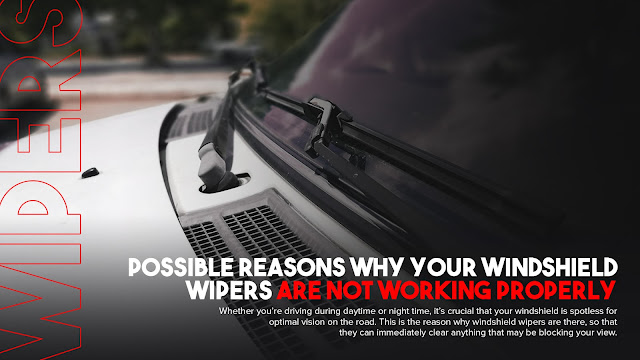
Here are some reasons why your wipers aren’t working. If you know how to fix any of these issues then it’s easier to get your wipers back on track but if you don’t, you can always take your car to a car repair shops to solve the problem immediately.
Whether you’re driving during daytime or night time, it’s crucial that your windshield is spotless for optimal vision on the road. This is the reason why windshield wipers are there, so that they can immediately clear anything that may be blocking your view.

But like any other equipment, windshield wipers tend to stop working. When this happens, it’s important that you don’t take it for granted or try to drive even with your wipers not working. You never know when unexpected rain or dash of wind blowing dust or leaves on your windshield may happen, so your wipers need to be operation all the time.

Here are some reasons why your wipers aren’t working. If you know how to fix any of these issues then it’s easier to get your wipers back on track but if you don’t, you can always take your car to a car repair shops to solve the problem immediately.

Your Wiper Blades Are Torn
The rubber edges on your wipers are designed to be tightly in contact on the windshield for it to swipe dirt, water, or anything that will compromise the driver’s vision on the road. However, if those rubbers are torn or there are gaps on it, then it wouldn’t be able to work as effectively. Once you see that they’re already not in good condition, it best to replace them already than continue using when it’s not even working properly anymore.

The Windshield Wipers Have Ice Or Snow On Them
This may only be applicable to those places with winter season, but it’s worth noting. Although windshield wipers are capable of clearing snow off the windshield, they can’t when the snow is too heavy and wet. If it snows in your area it might be best to invest in winter wiper blades, but if you can’t try removing most of the snow first before you use the wipers.

The Wiper Motor Has Failed
Just like any other electric motor, wiper motors sometimes fails due to short circuit or the motor is really old and needs replacement. In these cases, your wipers won’t work. You can either try to take your car to a mechanic for car repair or it may be practical to just replace the wiper motor. That may be more cost-effective than trying to fix an already faulty motor. 

The Windshield Wiper Fuse Is Burnt Out
In any electrical device, there’s always a fuse that acts as a shock absorber or sacrificial device for the entire device. This way in case the motor overloads, the fuse will be the one to take damage not the entire motor. But even though the motor isn’t totally damage, the wiper still won’t work. So you should look for the reason why the motor overloaded, remove it and change the fuse. This should settle the problem if the only damage is on the fuse. But if your wipers are still not working, seek car servicing as this may be more complicated than just the fuse.

Wiper Pivot Nuts Are Loose
When these pivot nuts are loose, the motor will turn but the wiper themselves won’t move. There are also instances where they will move slightly but won’t wipe the windshield or only one wiper is working while the other one doesn't. If you notice any of these, there’s a huge possibility that the wiper pivot nuts are loose.  The first thing that you should do is try to tighten them, if they’re already tight but you still see the same ‘symptoms’ it may need more than just tightening. Better seek a professional help, drive to your trusted car repair shop tell the mechanic your observations and the steps you’ve taken to try to solve the problem and let him handle the rest.

Miyerkules, Hulyo 3, 2019

How To Travel With Your Fur Buddy Safely And Stress Free

To lessen the stress and make sure you enjoy the ride, here are some tips that may come in handy.
For dog lovers out there, there’s nothing better than seeing places and being able to share the experience with your dog. However, despite the picture perfect idea, you have to be realistic and know that there are challenges when traveling with a canine. To lessen the stress and make sure you enjoy the ride, here are some tips that may come in handy.  

Try To Find Out If Your Dog Is Up For It
To minimize stress as much as possible, it’d be best to do a dry run first. There are dogs that do fine even for their first time while others have trouble getting used to it though they've traveled with you before. So if you’re planning a long road trip, try to practice with your pet first. Short trips every day may help him ease up to it so that he’s more relaxed once you actually go on a long trip.

Prioritize Safety
Letting the dog move freely inside the car may seem better but not when you’re on a long trip and you need to focus on driving. It could easily tire you out by constantly checking on him or keeping him calm and may put the both of you at risk of getting into an accident. You have to make sure you and your dog are safe throughout the ride. So better if you can fix him in one spot buckled up using dog-specific seat belts or put him at the back in his dog carrier. This way you know he is safe and you don’t get distracted while driving as well.

Don’t Leave Your Dog Alone In The Car
It doesn’t matter if “you’ll be back in just a minute” or not. Don’t. Leave. Your. Dog. Alone. In. The. Car. This is especially when it’s really hot because a parked car outside can easily heat up in just a minute and leaving your dog in there could lead to heat stroke.

Pack A Travel Kit For Your Pet
Especially on longer road trips, bring along a bowl, leash, food, pooper scooper, disposal bags, bottled water, their medications, grooming supplies, and any vaccination records if traveling across state lines.  Having your dog’s favorite toy, blanket or pillow along will also calm them down.  

Bring A Toy To Keep Them Busy
There are dogs who have anxiety issues or bark a lot, driving with either of them can be stressful and frustrating. But you can bring treats for them to chew or toys to play so that they have something to focus their attention to aside from the fact that they’re in the car traveling with you. Distracting them from the moving car helps soothe them so that you don’t have to worried sick the whole time.

Know Which Establishments Are Dog-Friendly
It would be a lot easier for you to travel with your canine if you know which establishment in your destination and even along it are welcoming dogs. This keeps you from stopping a couple of times to look for a place that allow dogs inside when you just want to buy a snack or need to use the bathroom. 

Be Careful What You Feed Your Dog
Always bring foods you know are safe for your four-legged travel buddy. This way you know you have something to feed him without running the risk of feeding him human food that’s actually toxic for him. Aside from that, if your dog has a tendency to jump on your food, make sure you keep it out of his reach to avoid any accidents.

Put An ID Tag With Contact Information On Your Dog’s Collar
It’s a scary thought, but you have to be prepared for the worst case scenario. If you know you have to do a lot of stops, especially in a crowded place, know that it’s possible for the two of you to get separated from each other. But if you do this tip, in case your furry friend ever gets separated from you, it will be easier for anyone to return him back to you.

You see, car repairs aren't the only headache-inducing thing that can happen when you’re traveling and kind of in the middle of nowhere. A scared or non-stop barking dog can be just as challenging. But being prepared and knowing what to do, especially during tricky situations, is always how you can overcome these bumps on the road.